12.12.11

Braised Pork Belly, Coffee, Orange, Chocolate, Black Pepper


I have an old friend visiting for a few days, so posting has been light.   Tonight we collaborated on a dish and produced a nice outcome.

Here we have pork belly, which was brined overnight in whisky, maple syrup, and dijon mustard.  Then braised for 6 hours in orange juice.  The meat itself is finished with a saute.  I added half a cup of additional orange juice and a couple tablespoons of red wine vinegar to the braising liquid and reduced to just a sauce consistency.  The acid and syrupy-citrus sweetness really helped cut some of the richness. The dish is garnished with a coffee-chocolate fondant tuile made from isomalt and glucose, which is also dusted with fresh ground black pepper.

Every aspect of this dish supports the rich succulence of the pork belly, which has been infused with the flavor of oranges.  I really need to comment on the use of coffee and chocolate though.  Not only do these flavors pair well together, but the black pepper on the tuile is complementary as well.   The really great part is how the coffee melds with the meaty aspects of this dish without clashing with the sweet/acid/floral flavors brought by the use of oranges.  I think that while coffee is often associated with the sweet/cold side of things, it has a tremendous potential in savory/hot dishes as well.  Some ideas are to use coffee as a braising liquid, or to cook something like short ribs en sous vide with coffee grounds, letting the natural juices of the meat infuse the coffee into the flesh.  Another idea would be to use a pressure cooker so to preserve the coffee's flavor with a shortened cook time.  I think the chocolate needs to play a background role in all this, if it is used at all, but it is a really nice touch that served to highlight the coffee.  Also, like in some hot chocolate preparations, the pepper works nicely to add a spicy kick to the whole thing.

I'm sure I'll be playing with this dish in the future, trying to bring forth the flavors more clearly, and balancing out the flavors as well.   As it stands, I think this dish is a nice start.

6.12.11

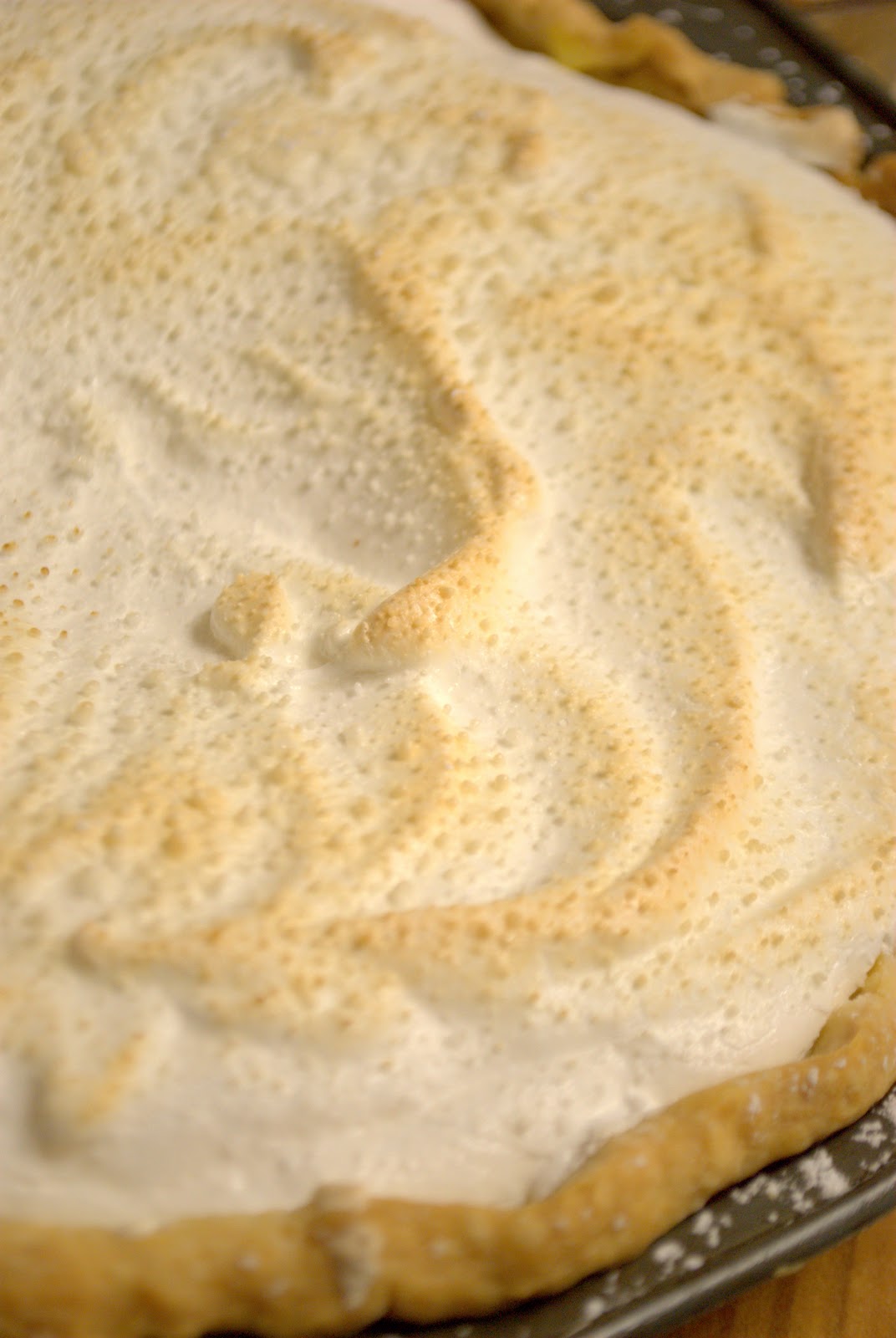
Lemon Meringue


When we lived in Houston, there was a 24 hour pie shop nearby.  Any time of day or night you could get delicious pies.  One of the best there was lemon meringue.  So, when I was choosing what pie to make, this was  natural choice.

There's nothing particularly complicated about making a pie like this.  I did this to get some practice.  The meringue is fairly labor intensive if, like me, you don't have an electric mixer.  Come to think of it, I don't have electric devices in the kitchen besides a blender.  Anyway, the pie dough is made first.  A simple mixture of flour, butter, and water (dash of salt for flavor).   The ratio seems simple enough, but I'm not completely sure whether it scales well.  3:2:1 is the ratio, by weight for flour:butter:water, at least in US measures.  Since I like using metric in the kitchen, the ratio is still roughly the same, but with small adjustments  2.88:1.88:1.   This is something I'm noticing more and more, but the ratios seem to be more often nice and neat (i.e. rational) with "US" measures (pounds and ounces)  than when using metric.  I'm not sure why this is.

The dough is chilled so the butter can firm up again, it is scaled to about 284 grams per crust and rolled out into a rough circle.


If you've made any sort of custard or pastry cream before, the filling is pretty much the same sort of thing.  Instead of a cornstarch thickened milk/cream mixture, you have cornstarch thickened lemon juice, zest, and water, egg yolks, and sugar.


The topping is a basic sweetened meringue.  A little more sugar than I'm used to using (e.g. for macarons), but still the same sort of thing.  For this, it is 2:1 sugar:egg whites.  

I had a little trouble getting mine to stiff peaks.  It seemed to want to stay in a ribbon stage after getting opaque and silky, almost like a cooked italian meringue. I think I still got decent results, though.

Deboning a Chicken

My first attempt at deboning a chicken.  I've never done this before, so like most other things, I turned to Jacques Pepin for advice.  He says one should be able to do this in about a minute.  Yeah, maybe after you've deboned hundreds of chickens.  Still, this isn't a difficult animal to break down.  Maybe someday I'll get a whole side of a pig or cow.

I used this to make a roast chicken.   I tourned some carrots, quartered some red potatoes, sliced some onions and seasoned them all with salt/pepper, thyme, parsley, and bay leaves. Tossed with some vegetable oil.  I then salted/peppered both sides of the chicken and laid it, skin side up, over the vegetables.   Seasoned with thyme, and a little extra salt (I love crispy chicken skin)

I then used a kitchen torch to pre-crisp the skin a bit just enough so that the skin contracted.   Then I put the whole thing into a 475 F oven until the vegetables were about half done.  I then took the chicken off the veggies and let them finish at 450 while the meat rested.

To finish, I put the chicken on a baking sheet under a broiler for a few minutes, until the skin was crispy all over and nicely browned.

In between these steps, I browned the giblets, neck, and wing tips in butter and let the chicken fat render.  I then strained the chicken fat into a sauce pan and made a roux with all-purpose flour.   Meanwhile, I deglazed the pan and simmered the chicken giblets and wingtips with 2-3 cups of water and a sprig of thyme.  Then I thickened the "quick stock" with the roux, and continued to simmer.  After straining, I had a flavorful gravy to go with the roast chicken.

To plate, I made a pool of gravy and spooned veggies over that, then laid a half chicken on each plate.   You'll have to believe me when I say this, but I'm not prone to hyperbole.  That said, this was the best roast chicken I've ever had.


Step 1: Sharpen your knives.

Step 2: Cut out the wish bone by scraping and cutting the meat around it.  Once you got it cut, pull it out with your forefinger and thumb.


Step 3: Flip the bird to expose the back.  Slice a seam down the bird, careful not to cut into the meat.


Step 4: Find the articulation point for the shoulder.  Twist and push up to expose it.

Step 5: Cut through the joint.  Do the steps 4 and 5 for the other side.


Step 6: Grab the shoulder, lift, twist toward breast and pull down to strip the meat off the bird.  This takes some force.


Step 7: Stop about 2/3 the way down.  The bit of meat called "the oyster" should be exposed.  Cut around it so it remains attached to the skin.  


Step 8: Continue to pull the flesh off the carcass.


Step 9: Now find the articulation of the hip. Life, twist and the ball joint will pull out of the socket.


Step 10: Cut through the joint and pull the body off the carcass completely.


Step 11: Find the tenderloins on the carcass.  They're located where the breasts  used to be.

Step 12: Using your thumbs, push the tenderloin off the carcass.  You may have to cut some silverskin.


Step 13: Lay the bird flat.


Step 14: Make slices around the thigh where the hip was.

Step 15: With the side of your blade, scrape down the bone, don't slice.


Step 16: Once you reach the "knee", slice around the top of the leg drumstick and continue to scrape down the bone.

Step 17: Break the leg and pull out the bone.


Step 18: Repeat steps 14-17 for the wings


Done


4.12.11

Cream of Tomato Soup


Cream of Tomato Soup; chicken stock, mirepoix (small dice), mushrooms (small dice), blonde roux, sachet d'epices, canned san marzano tomatoes, salt/pepper, heavy cream. Sweat mirepoix in fat, add flour and cook roux. Mix in chicken stock, tomatoes, simmer 30 minutes. Add sachet, season, simmer. Blend until smooth. Strain. Finish with hot cream.

Croutons; homemade sourdough, olive oil, salt/pepper. Toss, toast.

Felt like being brief today.  I just want to note that I am really starting to get a sense of how to do things, without reference to recipes.  Many of the basic techniques are repeated over and over.  Most importantly after execution is how to get flavor into the product.   For instance, this soup would not be nearly as tasty without the chicken stock, the making of a sort of chicken veloute, for the base of the soup.

Red Snapper, Parsley Potatoes, Tomatoes


This is a pretty simple dish, recipes drawn from CIA's textbook.  Red snapper with grapefruit-habenero salsa (red onion, grapefruit, habenero, minced parsley and cilantro).  The filet was dredged in flour before frying for a couple minutes on each side.  Had it with parsley potatoes.  Boiled "eighthed" potatoes, seasoned with salt/pepper, then sauteed with parsley and butter until cooked through.

I love simple dishes like this, which gives me an opportunity to taste new things and practice basic techniques like saute, boiling, knife skills like dice, mince, and supreme.  Good times.

3.12.11

Étouffé


Chicken and Shrimp Étouffé.  This is something packed with flavor.  Pretty easy to make since it involves basic techniques.  The base of this is a shellfish stock thickened with roux.  Brown roux.  It is amazing the complexity of aromas cooked flour and butter can produce.  The color and smell was of caramel, peanut butter, toffee, and maybe a little coffee.