Showing posts with label development. Show all posts

9.11.11

Salads

I've been thinking about salads lately. Their composition on the plate, as well as the palate.  They are part of the curriculum at culinary schools, which elevates their status.  Rightfully so, I think.  The more I think about it, the more I think of them as a test of one's ability to compose flavors and a plate.  The flavors will stand out, and each bite will be different, but hopefully share a common thread.  I'm mystified by what makes them work.  The salad I made below does work.  It is like magic to me.  I particularly loved the bites with the vinaigrette, the roasted pepper, and artichoke.  The herbs were sublime.


Blanched baby bok choy, baby carrots, artichoke; red pepper batons roasted with olive oil and salt/pepper; radish wedges; fresh tarragon, basil, oregano, parsley, thyme; on a bed of cauliflower which was put through a food processor to give it the consistency of cous cous, then simmered just until tender.

Vinaigrette of maille dijon mustard, salt, champagne vinegar, and toasted almond oil. The vinaigrette was awesome. We ended up using the remains of the artichoke and veggies as an excuse to pour it into our gullets.


2.11.11

Escoffier

"Where the steady, even pace of life is not troubled by any preoccupations,...,the art of cookery always flourishes because it contributes to one of the most agreeable of the pleasures given man to enjoy.
"On the other hand, when life is hectic,...,good living can only play a minor role.  More often the need to eat appears to those caught in the throes of business, as no longer a pleasurable occasion but an unnecessary chore.
"Such habits can and must be condemned, if only from the point of view of the health of customers whose stomachs have to put up with their consequences..."

To put this in context, Escoffier seems to be expressing his disdain for the changes he saw, while acknowledging that the cook and his craft is embedded in the society in which he or she lives.  A cook that refuses to accept the realities of the demands on diners is a cook without anybody to serve.  That said, he was making these observations in 1907 in the introduction to the second edition of Le Guide Culinaire.  I wonder what he would make of today's cuisine, at once more immediate, customer driven, and at the same time seemingly with more promise than at any time since his book was published or the advent of Nouvelle Cuisine.

1.11.11

Crème Fraîche

Crème fraîche really is expensive, and might be difficult to find in your standard grocery store.  Why not make it yourself?  Along with yogurt, fromage blanc, pasta, preserved lemons, and a host of other products, this one is much less costly to make than to buy, and very easy to do.

Crème fraîche is similar to sour cream, but I think it has a nicer mouth-feel, and has a wider variety of applications.  It has a sour note, but it also a hint of nuts.  It can be whipped to create a light structure.  It can be used in savory or sweet sides of the kitchen.  I've seen it flavored with fruits, curries, and more.  You can make dressings for salads or other vegetables with this, as it is a nice base for remoulade. It is also a great way to add richness to meat and fish sauces.  This will keep for a week to two weeks in the fridge.


The process is very similar to making fromage blanc (also called fromage frais).  For fromage blanc, you start with whole milk and add lemon juice with the buttermilk.  After heating these, you let it sit for a few minutes and strain to make the fromage blanc.  To make crème fraîche, start with heavy cream, warm it gently over low heat.  Then add two to three tablespoons of buttermilk.  You can use powdered buttermilk here (3-4 tablespoons per cup of water, mixed well).  Mix to incorporate the buttermilk and pour into jars, loosely covered.


Let the cream sit on a counter to at room temperature for 24 hours.  It will become thicker and start to develop some of its characteristic sourness.  It will continue to thicken and develop flavor as it sits in the fridge.  You can see that it is much thicker than cream. 


In More Depth


 I think there are two interesting things I want to highlight: fat and culture.  This is by no means a comprehensive discussion.

Fat

The fat in milk comes in the form of tiny globules.  Whole milk contains ~3.5% fat, while heavy cream contains upwards of 35%.  This makes cream better able to be whipped, resist curdling when heated, and gives it its characteristic mouth coating goodness.  The important thing to understand is that milk is a colloid, an emulsion of fat in water, held together with proteins.  You may know that raw milk will separate, the cream rising to the top.  Homogenized milk has been forced through a fine strainer at high pressure, breaking up the fat into smaller bits so they are more easily held in suspension.  Too much heat or acid and the emulsion will break.

I have often in the past tried using milk based products in making warm and hot sauces, but found that the fat and solids would separate, making a greasy and unappetizing appearance. What I was seeing were the proteins of the milk coagulating into a tight structure which  releases the fat and whey.  With heavy cream, and by extension crème fraîche, there is enough fat that the milk proteins are trapped, unable to curdle.  Sour cream will curdle with heat, as will milk and yogurt.  The reason for sour cream and yogurt is that their acidity already puts them on the edge, the heat easily pushing them to curdle.  More on acid below, under Culture.

The globules of fat also have a role to play when cream is whipped.  The mechanical action of whipping breaks up the globules into ever finer structures, which then can form into rings of condensed fat trapping air bubbles. If you continue whipping you break the globules and release the fat molecules, which will begin to coalesce into ever increasing sizes, producing butter.  Ice cream also illustrates the role of fat globules.  Like whipped cream, the fat stabilizes air bubbles produced when you churn the cream.   As a side note, ice cream is very interesting stuff with a lot to explore: the controlled crystallization of sugar and water, thermoreversability through the use of stabilizers, and tastes, all could be subjects in future posts.

You can make harder whipped creams by reducing the water content/increasing fat content (heat the cream to cook off some water), then chilling before whipping. To make softer whipped cream, add a bit of milk.  To aid quicker whipping, add a touch of acid (lemon, a dash of tartaric acid, etc).  This helps to separate the fat from the proteins.  That said, the amount of fat globules and the mechanical action of breaking them up is the key.

Culture


Milk fermentation.  Milk contains water, proteins, fat, and sugars (lactose).  It is this last molecule that makes fermented milk products possible.  The lactose serves as a food source for bacteria, which produce lactic acid, preserving the milk.  There are literally hundreds of different kinds of fermented fresh milks.  Each relies on a set of microbes to digest the sugars and acidify the milk.

Kept at moderate to warm temperatures, the microbes multiply rapidly and the process accelerates.  The acidic conditions produced by these helpful bacteria create an environment unfriendly to disease causing bacteria.  The acid also causes the proteins to get tangled up with each other, creating a gel structure which thickens the end result.  With yogurt and fromage blanc, the process is much quicker (yogurt can gel in a matter of hours, fromage blanc even faster).  The faster gelification of yogurt and cheeses produces a looser gel structure, which leaks whey and leaves behind the curds.   The slower process involved with crème fraîche creates a denser network of proteins, which retains the whey.

There's a lot going on, even in the ostensibly simplest substances.  We can easily take advantage of these complex processes to produce delicious results with very little cost.  I can only speak for myself, but I think knowing a little bit about what is going on to produce these foods increases my appreciation for them and helps me understand how to use them effectively in the kitchen.

Richard Feynman in What Do You Care What Other People Think? (1988)
I have a friend who's an artist, and he sometimes takes a view which I don't agree with. He'll hold up a flower and say, "Look how beautiful it is," and I'll agree. But then he'll say, "I, as an artist, can see how beautiful a flower is. But you, as a scientist, take it all apart and it becomes dull." I think he's kind of nutty. [...] There are all kinds of interesting questions that come from a knowledge of science, which only adds to the excitement and mystery and awe of a flower. It only adds. I don't understand how it subtracts.

The above adapted from my reading of McGee.  Any errors are my own.

29.10.11

Birthday Dinner

October 28, my birthday.

I used to want to go out to eat or something like that, but now I feel enough confidence in my cooking that I would rather make something for myself and the wife.  By coincidence I received the Bouchon and The French Laundry Cookbook in the mail a couple days before.  This has inspired me to make a few things the past few days, some of which I decided to do for my birthday.  While I cook every day, I think allowing me to make something delicious for others is a great birthday gift.  Nothing gives me more pleasure than offering such an experience to people.


I try to make as much from scratch as I can.  I do that so I can learn techniques and foundations.

For the appetizer I had some homemade lean bread, brushed with a honey-olive oil mixture and sprinkled with Maldon Sea Salt .  The bread is simple to make, requiring that you remember two things.  First, 5:3 ratio of flour to water.  This is the basic structure for the dough.  Adding a teaspoon of active dry yeast per 15-20 ounces of flour gets the bread to rise.  A bit of salt in the dough gives it flavor.  From there, you can make all kinds of variations from olives, roasted garlic, hard herbs, and I've made a chocolate/olive/walnut bread which was deliciously sweet & salty.  Second, you have to remember knead, double, knead, rest, shape, proof, or more simply: rise twice, rest twice. The kneading develops the gluten structure, which traps and holds the water and starch (food for the yeast).  The doubling gets the yeast time to be active.  The second kneading redistributes the yeast to new supply of starch.  Shaping and proofing allow the bread to develop its structure and the air pockets to develop.   It is important to knead enough so that the bread is elastic or you'll have flabby and dense bread rather than a light crumb.  Once you get the hang of it, it won't take you longer than about 30 minutes for the initial mixing, then it is mostly waiting and baking.  The kneading is also a great stress reliever and the results more satisfying, I think. The results will blow away your typical bakery and grocery store bought bread.

With the bread, I made an olivade. Homemade fromage blanc with chopped olives, capers, red onion, chives, tarragon.  Not finding fromage blanc at the grocery store, I decided to make my own.  Turns out it is very easy, and much cheaper to do yourself.  It requires a couple tablespoons of lemon juice, buttermilk, and whole milk.  You can add a bit of heavy cream to make it richer, but it isn't strictly necessary.  Lacking fresh buttermilk, I reconstituted  dried buttermilk I had left from a previous recipe to make a cup.  Mix the buttermilk and lemon juice, then add this to about a liter of milk.  Stir to incorporate and heat gently to 175F.  Stir a couple times, but leave the milk to heat on its own.  Make sure you don't scorch your milk (i.e. watch the temp closely).  Once it reaches 175F, take it off the heat and let the milk rest for 10-15 minutes.  Then carefully strain away the whey, leaving a very soft curd behind.  There you have it.

For the spread, I pitted and finely chopped some kalamata olives, minced some red onion, capers, chives, and tarragon.  Seasoned lightly with salt and pepper, this made a great spread for the bread.  It can also be used with meats, salads, fish, etc.


Next, I made a roasted beet salad.  I thought to add variety by using both gold and red beets here.  Beets were roasted in a foil package at 375F for about an hour to hour and a half with some olive oil, salt, and pepper.  Then quartered and marinated in a tablespoon or two of olive oil, sherry vinegar, and fresh squeezed orange juice for at least half an hour in the fridge.  I added chopped red onion, chives, and tarragon to finish.  This is a sweet and refreshing salad, very simple, and delicious.


For the main course, I had salmon with leeks.  The salmon was seared on one side until done half way through to produce a crispy skin and render the fat, while leaving the salmon tender. Leeks blanched until fork tender. Beurre blanc. Tender and succulent, the rich taste of salmon balanced well with the leeks.  The skin, with its fatty substrate was absolutely delicious with the tender flesh of the fish and leeks. Beurre blanc was made with a reduction of shallot, bay, and thyme infused in cotes du rhone and champagne vinegar until syrupy.


For dessert, I went simple again.  This is a basic vanilla custard creme caramel.  The caramel is made by melting sugar and water with some glucose (which helps inhibit crystallization of the sugar).  The caramel is then poured into the bottom of a few ramekins and left to cool and harden.  The custard is very easy.  5 whole eggs and 3 egg yolks beaten to smooth in a bowl.  Then, in a sauce pan, 4 cups of milk is mixed with a cup or more of sugar (depending on how sweet you like it).  Flavorings can be added here by incorporating extracts like vanilla, almond, etc., or by infusing mint and so forth.  Bring the milk to below a simmer, just so the sugar dissolves completely.  Then, let the milk cool a bit.   Whisking constantly, slowly pour the warm milk into the egg yolks.  Strain into a container with a spout so you can pour this into the ramekins.  Set the ramekins in a baking pan with hot water up about 3/4 to 2/3 the sides of the ramekins. Finally, bake at 300F for 30-50 minutes until the custard sets.   You then let the ramekins cool and chill in the fridge for a couple hours, at least.  When you're ready to serve, put the ramekins in a hot water bath for 30 seconds to a minute to loosen the custard.  Run a paring knife around the edge, carefully.  Put a plate upside down on top of the ramekin and invert.  The custard should fall out and, because of the hot water, the caramel will have melted and create a sauce on top.

24.10.11

Basic Knife Skills

Allumette

Every cooking school I've read about and every chef I've seen talk about essential skills of a chef starts with knife skills.  This is an interesting topic to me because it seems obvious at first, but if you consider the whys of this starting point you see how there is much more to it than simply knowing how to chop vegetables.

Allumette -> Small Dice
Of course, making even equal cuts serves two purposes.  First, it allows for even cooking so your food reaches temperature and texture at the same time.  It is a disaster if some of your potatoes are done cooking while other, larger, pieces still have a ways to go.  Second, a good cut is pleasing to the eye, while uneven cuts make a plate look sloppy.  This doesn't mean all cuts need to be platonic, but it does mean that your pieces should be isometric.

Julienne
There is another reason, one that I think is no less important, although it is a subtle point.  Learning to making even cuts trains you to be laser focused on details.  It seems to me that this in particular has profound implications for the rest of your cooking beyond the mechanics of heat application or the aesthetic qualities of your dish.  The attention to detail separates good from great.  The finesse you pick up separates great from legendary.

Julienne -> Brunoise
I think knife skills also send a signal, to superiors and your guests, that you take your craft seriously. Also, it signals that what they are about to eat was prepared with care, and is likely to be good.  Sloppy cuts signal that you're too busy or careless to craft the dish--that what they are getting isn't your best effort.

Batonnet

23.10.11

Dinner 10-22-2011


After what feels like a long break (from the blog, not cooking), I'm back.  You might consider this a preview of the kind of thing I would try to do in the underground restaurant.  We had some people over for dinner last night.  For me this means an opportunity to put what I've been learning to good use.   Each dish really stood on its own.  I think each is visually attractive, and interesting to eat (like cracking through the prosciutto covering on the 1st dish).  That said, what I'm most proud of is that the overall progression of the menu felt coherent.


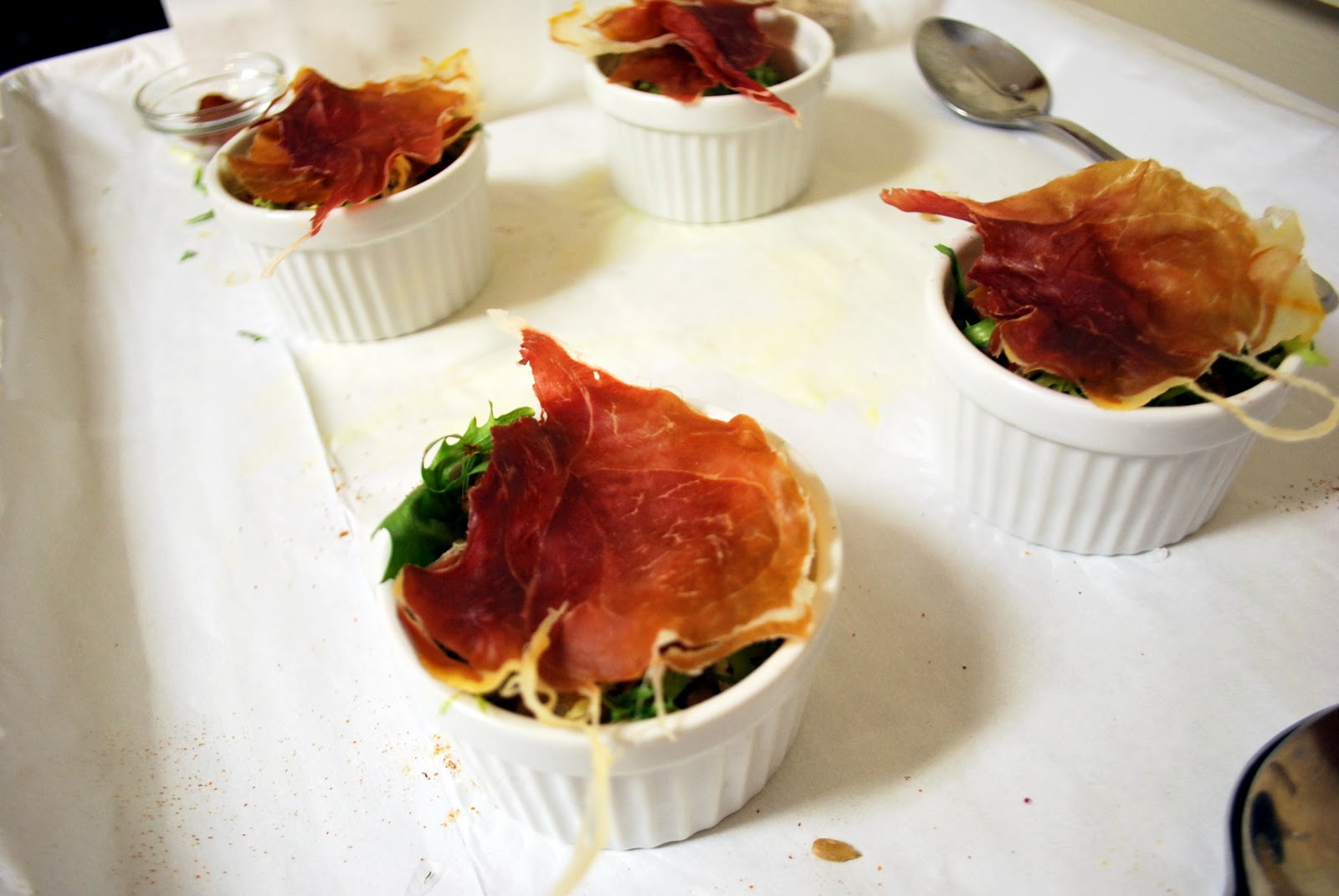
Poached egg, reduction of chicken stock, dijon mustard, roasted sunchokes, frisee, toasted sunflower seeds, dehydrated prosciutto di parma, cayenne pepper.

This is a fun one to eat. The diner has to crack through the crispy prosciutto to get to the dish, which is fun and dynamic. The crispness also adds a nice dynamic to what is a rich soupy dish with toasty notes, sweetness from the carmelization of the sunchokes, while still remaining earthy in nature. I only heard groans of pleasure from this one.


Pan-seared scallops with crushed fennel seeds, puree of peaches infused with cream, arugla leaf, and mint leaves.

I wanted something simple, not crowded with flavors because these scallops are fresh and cooked to a creamy medium-rare. The fennel really highlights the sweetness of the scallop here and the bitter arugala adds a nice contrast. The peach cream added a sweetly accented richness. A lesson in allowing the central ingredient to really shine.


Zucchini and yellow squash julienne, then tenderized for 20 minutes in salt. Accented with a lemon-lime soaked shallot (they turn a beautiful pink color in the presence of acid), and toasted almonds.

This dish served as a palate cleanser with earthy and sweet/sour notes. The texture of the zucchini and squash is like an al dente pasta. Crunch added with toasted almonds. A visually pleasing and tasty palate cleanser.


Candied roasted hazelnuts, smoked provolone, candied lemon zest, beer gel sheet, pink peppercorns.

The flavors stand individually and work in concert in this one. The beer I used was a Hoegaarden white ale, which has a subtle citrus note accented with the lemon zest. The candied hazelnuts had extra crunch due to their candy shell and were also salted, adding another nice contrast. Supported by smoky provolone. The pink peppercorns really did wonders to highlight the fruity aspects of this dish.

There's also the striking visual element here. I was happy with my efforts on this dish, but I see room for improvement.


Pan seared filet mignon, red wine reduction with reduction of beef stock, black mission figs, braised bok choy.

Tender beef, sweet tender fig = heaven. The bok choy was juicy and still had some crunch. The sauce is rich while retaining the nice subtleties of the bordeaux wine I used. Can't go wrong with this cut of meat, I think....unless you overcook it, which I didn't, so....there.


For dessert, I made eclairs, which I've attempted to make only once before. This was my best effort yet. The eclair shells were just about right hollow, dry, mostly crack-free, and relatively straight and even. The fondant was easy to make, but some practice is needed to get it to the right consistency with water/glucose when it is melted down. Also, the glazing needs more practice. Definitely a reject by professional standards, but I'm happy with it overall. A great achievement for at home, I think.

The eclairs are filled with an almond flavored pastry cream and a coffee flavored pastry cream. Choux and pastry cream recipes generously provided by Chef Francisco Migoya (www.thequenelle.com).

14.10.11

In search of inspiration

I haven't posted in a few days for a few reasons.  Prime among them is my recent struggles with macarons.  Tricky confections to make, indeed.  I've never experienced heartbreak like this in the kitchen before, or for that matter such a thrill from success.   I'll have a post on my efforts with these prized Parisian cookies soon (as well as a posts in the works on spherification, a meditation on variation and simplicity in cooking).

To be honest, I'm not sure where all my efforts will ultimately take me.  The constant questioning and self-criticism makes me wonder if I can really strive for what inspires me and succeed.  Do I have the energy and imagination for the kitchen?  Seems like a calling for the young.  34th birthday coming up.  Maybe subconsciously that's driving this self doubt.  I mean, I read about 24 year-olds working in Michelin starred restaurants and think...what the hell am I thinking?  Am I crazy for wanting to do a stage in a restaurant here?  At my age... 16 hour days of hard labor...yeah right.

Yet, there are small victories.  Silly thought it may sound, I derive great pleasure from handling my knife better and better day after day.  The ability to cut effortlessly, quickly, and unthinkingly is a manifestation, small though it is, of progress.  The tray full of macaron success was a high point.

And then there is the French Laundry.  Unlike others who are doing great work, I am inspired by what goes on there.  A lot of times I see what some people are doing with their art and think...fuck me, I could never do that.  But somehow, one of the greatest evokes the exact opposite.  The simplicity and flawless execution makes me think I can do it.   I guess that's what makes the French Laundry so great in my eyes.  They make it look easy, but the more I learn the more I know, this shit is hard.

Today is another day.  Time to push a little further.  Practice a little more.

1.10.11

How does one learn to cook?

  Michael Ruhlman had a recent post about cookbooks that teach.  Of course, cookbooks can serve as references for recipes and ideas for cooks at any level.  And, as Ruhlman points out, they can be written didactically, one of their important functions.  It seems to me that it is also crucial to be able to read recipes comparatively.  What is different in one recipe from another?  Why are they different?  What are the effects of changes in proportions of the ingredients. This is something I want to do more of.  So, I thought I would start by taking stock of the books I have so far.  I'll write annotations for my books and put it on a page later today.

Note: If you're using an ad blocker, you won't see the links to Amazon.com .  Disable the ad block for this site only (I promise there are no ads enabled, only links to the books).  In Google Chrome, click the ABP icon in the address bar and uncheck "Enabled for this site".


 Not cookbooks, but cooking and food related:
 

30.9.11

Welcome to Cook & Dagger!

  For the inaugural post on Cook & Dagger, I thought I would talk a little about how this whole thing got started.  In later posts, I'll elaborate a bit on why I am starting an supper club-cum-underground restaurant, my philosophy on food and eating.


My interest in food relatively recently started to rise very quickly after tasting a dish from the Alinea cookbook. It was prepared by a friend in Houston while we were in a PhD program together. It radically changed the way I think about what a dish could be and what food could do.  Sure, it was a visceral experience, but that's true of eating generally, I think.  What worked for me was that it not only engaged my senses but, through them, my mind as well.  Prior to that experience, I was skeptical of these newfangled techniques he was talking about...spheres out of food...huh?  After that, I was on board, 100% and then some.


I quickly ordered a basic spherification kit from WillPowder and started experimenting (photos here). Soon after, I got the Alinea cookbook and jumped into the deep end, preparing a 7 course meal for a few friends.  While the two days of cooking were highly stressful, I had some help from aforementioned friend.  The response was incredible.  I heard things that seemed to come from the same feelings that I had with that first dish.  I did it!  Word spread about the dinner, and I was invited (commissioned) by another friend to have a dinner, on their dime.  I jumped at the opportunity and decided I was going to go bigger -- 12 courses this time, and 8-10 people.  By myself.  While 2 of the courses weren't presentable, I pulled off 10 courses in 2.5 hours (some photos here).  Another success under my belt, and I knew this is something I was having fun doing and I was passionate about it.


Since then, I left Houston with M.A. degree in hand (yes, I finished all my coursework, but did not feel a dissertation was in me).  My focus has been on learning fundamentals, trying new things, and practice, practice, practice.   Why blog? I see it as a way to document my progress as a self-made cook.  In part, this is to serve as an inspiration to myself.  To see where I've been and how far I've come.  Cooking offers many opportunities for failure, so I also think this may be an inspiration to others who want to allow their reach to exceed their grasp.

I'll post experiences and experiments with food and techniques.  The blog will also serve as the central focus of a supperclub called Cook & Dagger  (e.g. announcements about upcoming dinners, previews of dishes, menus, etc.)