5.2.12

Coq au Vin

Another post involving a braise.  This time its the classic Coq au Vin.  Braises are great because they create a warming rich sauce packed with flavor.  This one has wine and stock as its base.   I'm not going to say much about this because there are 1001 recipes online.

My chicken was served with potato puree (just how much butter can YOU pack into a pound of potatoes?), halved baby carrots, and haricots vert, both blanched in salted water, and sauteed mushrooms.


The only thing I'll mention is that I was happy with my technique on this one.  Fluting mushrooms is much easier.  Also, I'm always happy when vegetables are cooked properly.  I hate under/over cooked veggies.  I don't know why, but it really makes me sad to see poorly cooked veg.


Dinner 01-20-2012


Roasted beet  salad, marinated in grapefruit juice and red wine vinegar, with chopped tarragon, chives, shaved red onion, and a drizzle of olive oil.  Sweet and refreshing as always. 


I think braising is my favorite technique. Makes a great sauce, and tenderizes cheap, tough cuts of meat. Beef short ribs pan seared then braised. Braising liquid starts with sweated bell pepper, jalepeno, onions, garlic. Then added san marzano tomatoes, tomato paste, 2 cups of strong coffee. Sauce is finished with a cup of unsweetened chocolate. Garnished with chopped cilantro.

This dish was great.  I like things that really concentrate their effects on the nose rather than fooling you into thinking tastes are on the palate. The coffee and chocolate give this dish a mysterious aroma  that pairs extremely well with the browned meat.  The red bell pepper you don't taste directly, but I think it adds a very subtle sweet highlight, which accentuates the chocolate aroma.  The cilantro and jalapeno give this dish an earthy/spicy balance.


Gateaux aux amandes. So tender and light in texture. Elegant flavor of almond. Served with a spoonful of a strawberry-rhubarb compote like thing, and whipped cream (siphon method).

Merveilleux

I do love to make (and eat, of course) desserts.


Merveilleux, a French confection. Two sweet meringue cookies with a layer of chocolate mousse, then covered with vanilla flavored whipped cream and shavings of chocolate.

Start by forming a french meringue.  I used two egg whites, a quarter teaspoon of citric acid, and about 200 grams of sugar.  In the mixer, I whipped the eggs and acid to a froth, then added the sugar all at once.    I then let the mixer go on high speed until stiff peaks.  Once the meringue reaches the right consistency, I put it into a piping back with a 1 cm plain tip.  

The whipped cream is made in similar fashion, but no acid.  I put a cup of heavy cream with a half teaspoon of vanilla extract and maybe a third of a cup of sugar.  I let this whip until stiff peaks as well.

The chocolate mousse I made by melting chocolate in a steel bowl over a saucepan with simmering water.  I added some cream and whipped like mad over an ice bath.  

Now that the components are made, time to bake.  The meringues were piped into 4 cm disks on parchment paper and baked at 195 F (90 C) for 1 hour, then 185 F (85 C) for another hour. I cut one open to make sure the centers were baked through.  If not (mine were not since I made them a little thick), bake for 10-20 minutes more.  Let cool completely


To finish, I spread chocolate mousse on one disk and placed another disk on top.  I covered the meringue sandwich with whipped cream using an offset spatula.  Finally, roll in chocolate shavings.  

30.1.12

Striving

Sometimes inspiration comes from areas far outside one's area of study (in my mind we are all students in one way or another).  I just wanted to share a couple of things that have been on my mind.

First, a post from The Incidental Economist on what it means to be a professional (something I've thought about as I try to reconcile multiple definitions of the term "chef"):

My views on professionalism are highly influenced by Lessons in the Fundamentals of Go, by Toshiro Kageyama (1978). Kageyama was a professional Go player who reached 7-dan in 1977.
Each spring sees the opening of another baseball season. This is one of my favorite spectator sports, but every year there is one thing that bothers me about it. That is the way that semi-professional, university, and sometimes even high-school stars enter the [Japanese] professional leagues and immediately display a skill that puts their veteran teammates to shame. There hardly seems to be any difference at all between amateurs and professionals. Amateurs play for pure enjoyment, while professionals play to make a living. The difference between them ought to be much greater.
In every confrontation with a real American professional team it seems that what we need to learn from them, besides their technique of course, is how uniformly faithful their players are to the fundamentals. Faithfulness to fundamentals seems to be a common thread linking professionalism in all areas. If we consider the American professionals as the real professionals in baseball [circa 1978], then I think we have to consider their Japanese counterparts, who tend to pass over the fundamentals, as nothing more than advanced amateurs.
The reason for the lack of polish in Japanese baseball is probably just the short history it has in this country. [...] I feel certain that no racial physical inferiority consigns us to second place. [...]
A professional has undergone elite training in competition from childhood; [...] His mental, physical, and emotional strength all have to be fully developed. If  he lets up anywhere, it will show in his performance. [...]
No professional regrets the time he has to spend studying. [...]
Professionals do this unquestioningly. Even a gemstone has to be polished. ‘A man is always moving either forward or backward,’ says Kano, 9-dan. ‘He never stands still.’ [...]
[T]he fundamentals have to be handled subconsciously. For example, if you watch the way a star infielder moves in baseball, you will observe that no matter how difficult the bounce or how hard the line drive, he meets it frontally, faithfully following the fundamentals. The ball comes at him in a fraction of a second. The question is not how well he understands the fundamentals intellectually, but whether or not his body can respond instantly. What you are seeing is the result of long days of practice and effort. [...]
You have to soak up the fundamentals as you practice on your own, studying them until they become part of your very being. If the fundamentals do not operate subconsciously [...] you have not mastered them yet.
And so it is, in baseball, Go, and all things. I think of these words often when I observe the pinnacle of performance in any field and when I see amateurs striving for professional-level performance.
Second,  a post from John Cook, a programmer based in Houston (I think):

From The First Circle by Alexander Solzhenitsyn:
Now listen to the rule of the last inch. The realm of the last inch. The job is almost finished, the goal almost attained, everything possible seems to have been achieved, every difficulty overcome — and yet the quality is just not there. The work needs more finish, perhaps further research. In that moment of weariness and self-satisfaction, the temptation is greatest to give up, not to strive for the peak of quality. That’s the realm of the last inch — here, the work is very, very complex, but it’s also particularly valuable because it’s done with the most perfect means. The rule of the last inch is simply this — not to leave it undone. And not to put it off — because otherwise your mind loses touch with that realm. And not to mind how much time you spend on it, because the aim is not to finish the job quickly, but to reach perfection.
It can be hard to know when something deserves the kind of polish Solzhenitsyn talks about. Sometimes you’re in the realm of rapidly diminishing return and it’s time to move on. Other times, the finishing touches are everything.
I like both of these posts because they deal with something I struggle with daily and seem to fit nicely together.  At the start of any endeavor, you must struggle with the fundamentals by learning to accomplish the most basic tasks with excellence.  You also must push your boundaries and get that extra 1-3% of refinement.  That extra push at the end that is referred to in John Cook's post is a moving target.  As a novice you learn fundamentals and the last inch is about something different than if you're Thomas Keller and at the top of the game.   While the same terms may apply (finesse, refinement, ???), the first post addresses that it isn't until that last inch towards unconscious skill at a task is achieved that you have a new last inch to push towards.

Olive Oil Gel

It has been a while since I've written anything in this space.  It isn't that I've been completely inactive, just lazy about updating the blog.  There is some catching up to do.  Regular posting commences...now.

One of the things I'm committing to is work on creating new dishes.  To this end, I started a tastes diary of sorts where I write down ideas for things that I come across by accident (soy sauce/toasted walnut oil, granny smith apple/roasted garlic/white chocolate...etc.) and tastes I enjoy in dishes I've attempted.

As a further step in this development is learning to create new textures and flavor combinations with techniques I have learned.  That is what is below, as a test.  

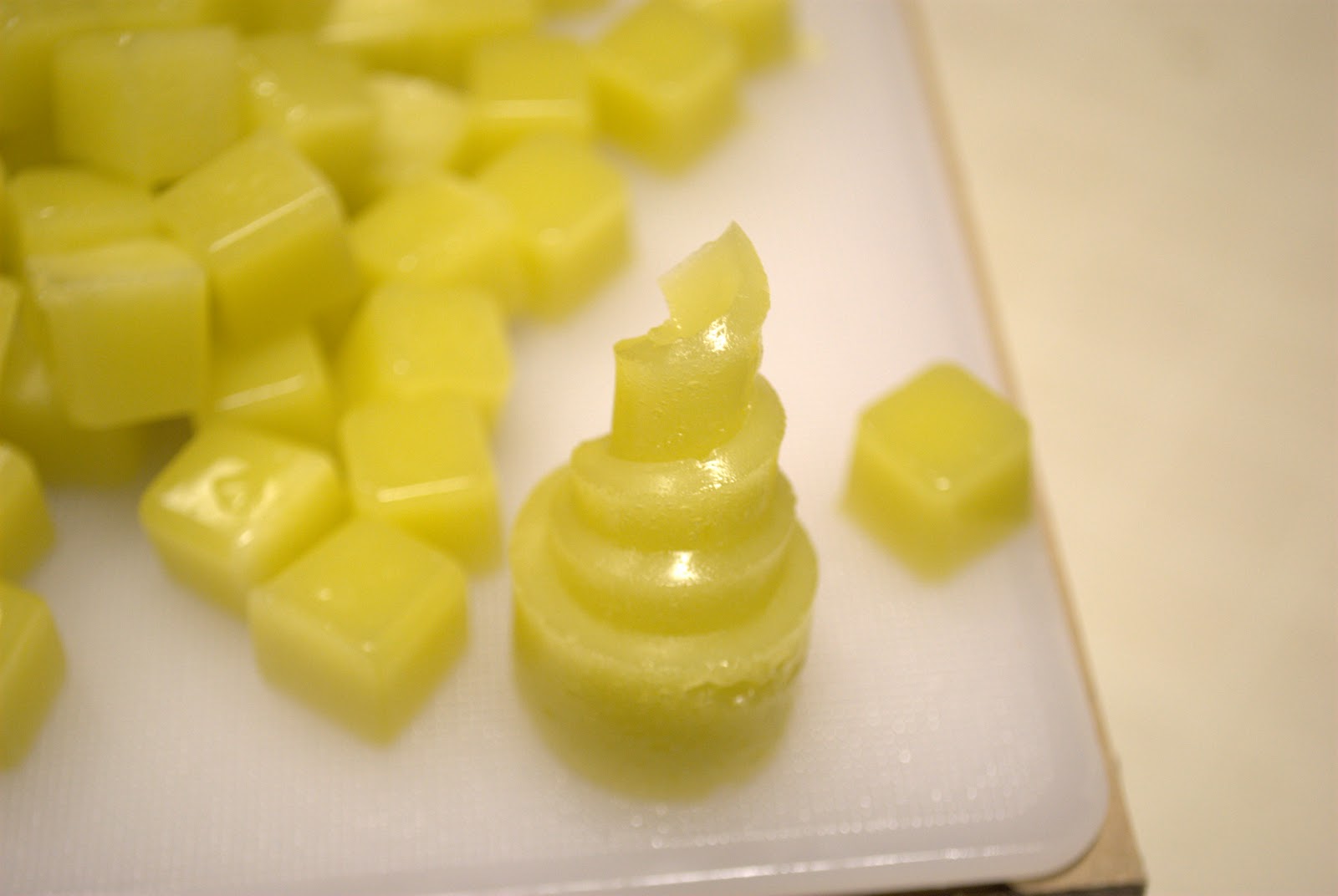
I took some olive oil and made a gel out of it.  This isn't an invention of mine, but something I wanted to add to my repertoire. It is really quite easy, if you've made gelatin before.  I made a couple of shapes.  First were cubes, which I think mimic croutons.  Second, I made a thin sheet, which I then cut up into strips and rolled. 


The manipulation of ingredients into different textures and shapes often brings excitement to a plate.  I've experienced this.  I'm not sure why, but these sorts of things do have an effect on the taste.  At least a partial explanation might be that we (I, at least) pay more attention to the taste of the food when it is presented in an unusual way.  Whereas something like olive oil might pass nearly unnoticed, the fruity mouth coating deliciousness of a piece of this gel is quite prominent.  The gel helps, too, keeping the oil on the palate for a longer period of time. (As a side note, interesting research into this topic.)


I'm looking forward to refinement and learning how to make more components of dishes like this.  Time to let the creative juices flow.


water 100 ml
glucose 25g
sugar 80g
isomalt 100g
olive oil 200 ml
5 sheets gelatin (silver strength, so I think I used about 15 grams)

1. heat/dissolve sugar, glucose, isomalt in the water
2. At around 90C, add in bloomed gelatin
3. Add olive oil and blitz in blender/immersion blender/food processor
4. Pour & set

(Recipe adapted from khymos.org)

22.12.11

Vacation

Posts will be light to non-existent while I'm away at my mother's for the Christmas and New Year's holidays.  Back in early January, with new challenges in cooking and new adventures to come.

18.12.11

Dinner 12-17-2011


I think this may be the last dinner before the new year.  We had another old friend visiting and the wife decided to invite some people over.  So I was cooking for 6 guests plus myself. One was the former head of her department at the college, now retired, and his wife.  The other is a current professor in the same department, and his wife.  Both couples are experienced travelers and eaters in Europe.  I know they've been to some fine restaurants there, and here in the U.S.  It would be fun to cook for them.

I decided to go with a little tour of French cookery.  Mostly to get their impressions given I have no reference point for what most things ought to be like.  (Impressions were favorable...whew!)

First  up was a little charcuterie plate with cornichons and dijon mustard.  I served fennel salami, smoked prosciutto, and rabbit pâté.  The only part of this I made was the pâté.   Lacking a meat grinder, I put the meat and fat through a food processor several times.   This was a fun one to make.  After cutting up the carcass of the rabbit, I deboned it and let it marinade with thyme, salt, bay leaf.  Then this is ground up with some pork fat back and pieces of bread soaked in milk.  The last touch before cooking is the addition of some mustard with cognac.   This is wrapped in bacon and then baked.  Once cooled, it is compressed with weights and left to chill, sliced, and served.

With the charcuterie I served two breads that I've made before: a sourdough baguette and brioche.  I need to work on my shaping skills....I'm masterful at making exploding baguette, which is caused by the loaf splitting at invisible seams in the dough rather than the scores I make.   The brioche was probably the best I've made so far.  This is Keller's recipe in Bouchon.


For a first course, I decided to do a "fruits de mer" platter.  I like this because the food is cooked simply, with finesse, and presented in a way that signals abundance and festiveness.

A few of the items are poached in court bouillon.  This poaching liquid consists of water, veggies (leeks, onions, carrots), herbs and spices (bouquet garni), dry white wine, lemon, and vinegar.  The lobster, crab, and shrimp are all poached for a few minutes in the liquid before being chilled.  The PEI mussels are cooked simply in a thin layer of boiling water before also being chilled.


I had fun with the oysters and clams, having never shucked either before.  It turns out to be pretty easy, and there's something gratifying when you feel the shell first pop loose.   These were served raw with three sauces.


 Starting at the top image, a cocktail sauce (easy: ketchup, worcestershire, mustard, horseradish), a mignonette (red wine vinegar, shallot, black pepper), and dijon mustard mayo (egg yolk, oil, salt, pepper, lemon juice, mustard)


The next course was a meat.  I love duck so much that I made it yet again.  I switched up the spicing and used finely ground coffee, salt, and pepper.  I made the port wine-sherry beurre monte again to sauce the meat.  This time served with sauteed spinach.    The other side with this was a red rice cooked in chicken stock with chestnuts and garnished with thinly sliced burgundy truffles.   This clearly isn't presentation for haute cuisine, but my oh my did the red rice-truffle-chestnut combo work, especially with the duck and the sauce.


Dessert came in two stages.  Again, not winning any awards for presentation, but still...so delicious.  First was a plate with baked balls of pate a choux, a pastry dough that we've seen before in the form of gougeres and eclairs.  This time is a form of 'profiterole' where vanilla ice cream is sandwiched between the two halves of the hollow ball of dough.  Topping this, admittedly somewhat haphazardly, was a simple chocolate sauce.  

On the side of the dish were poached prunes.  These were so so flavorful, and sweet, so meltingly tender, that I am sure to do this again with other fruits.  The prunes are left to marinate in red wine (cabernet sauvignon), with cinnamon sticks, star anise, and honey.  I added thai long peppercorns and some nutmeg, which I think are complementary flavors.  After sitting in this mixture overnight, the prunes and liquid are brought to a simmer only briefly to soften them, and  then left to sit and chill at least for a day. 

After dessert, we had some digestifs.  Available were cognac, scotch.  We also had some coffee.  Along with these, I made a strawberry-rhubarb tart and a cocoa flavored cookie topped with chopped walnuts.